
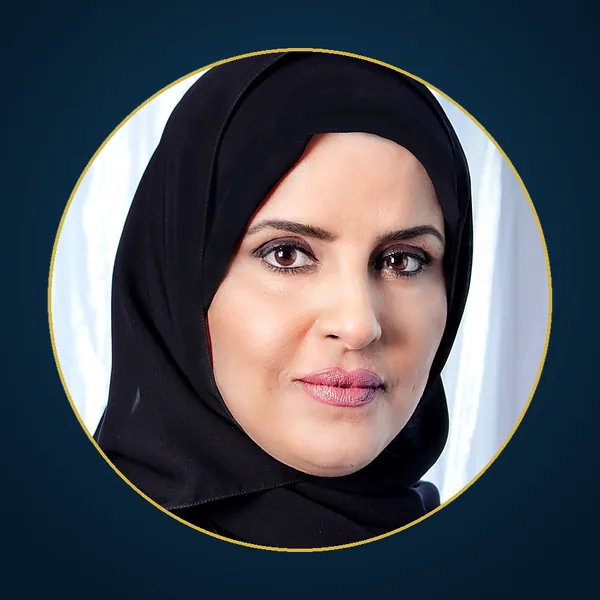
Amal Al-Mannai
She transformed individual social initiatives into sustainable institutional work, placing service to those most in need at the heart of public responsibility.
2024 edition · source pages 62–69
Profile
Amal Abdul Latif Al-Mannai is the former Chief Executive Officer of the Qatar Foundation for Social Work and a leader in institutional social development.
A Teacher’s Daughter and a Name of Promise
She was born into a traditional Qatari family of four daughters and three sons. Her late father, the first Qatari teacher in the northern region, later worked in Doha, at the Ministry of Education and in the Shura Council. His ability to anticipate change, analyse circumstances and embrace travel and discovery strongly influenced her own curiosity and leadership.
As the family’s first granddaughter, her name became the subject of a friendly dispute. Her paternal grandfather wanted Maryam, after his mother; her grandmother insisted on Amal, after the first female school principal in Abu Dhalouf, the home of the Al-Mannai tribe. The grandmother admired that pioneering woman’s strength and hoped the child would follow a similarly distinctive path.
She attended Al Montazah Primary School and Amna Bint Wahab for middle and secondary education. After excelling in the science stream, she planned to study medicine in Britain, but her father could not accept the separation. She entered Qatar University’s College of Science, then explored English and economics as she searched for the discipline that best suited her abilities.
Social Work Becomes an Institution
Her first professional role was two years of teaching at Khalifa Secondary School. Close to the pupils and active in school initiatives, she contributed to environmental-awareness campaigns, including an anti-smoking project that collected cigarette butts. Aisha Abdullah Al Ansari, then a school leader and Vice-Chair of the Family Development House, recognised her inclination towards community work and nominated her for a role at the House within Qatar Foundation.
In 1997, she entered social work and immediately felt that the field matched her character. Conservative expectations initially made her careful in every decision, but field experience enabled her to establish respect for both her work and the objectives she pursued across institutions and partner organisations.
Projects Designed to Endure
The charitable diplomatic market, created in 1999 alongside the launch of the Family Development House under the patronage of Her Highness Sheikha Moza bint Nasser, brought together women from different diplomatic communities. Further initiatives included the KAFU volunteering-awareness campaign, charity dinners and endowments such as Al-Balsam and Al-Bir, all designed to sustain services rather than depend on short-term support.
Other projects included the Sheikha Haya Factory, which created work opportunities for women; the Qatar International Beauty Academy, which trained young women for employment; and a business incubator developed with Qatar Development Bank to encourage entrepreneurship and self-reliance. The final five years of her executive career focused on organising and restructuring the Qatar Foundation for Social Work and the centres under its umbrella.
Field responsibility led her to management study at the University of London and a diploma programme lasting less than two years. In 2001, an intensive programme took her through seven American states to examine how organisations managed social-development projects for vulnerable groups. She later completed a master’s degree at the American University of Beirut, balancing heavy institutional responsibilities with study from 2006 until graduation in 2008.
Governance and International Recognition
Her central achievement was helping move social work from spontaneous, short-term intervention towards specialised and governed institutions with defined missions, sustainable services, medium- and long-term plans and tools for measuring results. The shift strengthened civil-society organisations and gave social services clearer structures for development.
She served on the juries of the State Appreciation and Encouragement Awards and the Akhlaquna Award. Under her leadership, the Foundation also secured consultative status with the United Nations Economic and Social Council, an institutional achievement extending beyond one organisation to Qatar’s civil-society sector.
Leadership Changes Expectations
The vision of Her Highness Sheikha Moza bint Nasser remained a decisive influence, particularly the aim of making Qatari society a model for innovation, sustainable organisation and high-quality social services. That vision gave direction to initiatives developed across more than two decades of community work.
Public leadership required a gradual challenge to family and social expectations. Her first media appearance came at the opening of City Center Doha by Sheikh Faisal bin Qassim Al Thani, where a corner had been allocated to products made by productive families. When His Highness the Father Amir Sheikh Hamad bin Khalifa Al Thani attended and a photograph of the ribbon-cutting appeared in newspapers, she initially hid the copies from her brothers. Persuasion, achievement and her father’s later support eventually dissolved that fear.
Recognition included the GCC civil-society pioneers award in 2011, presented in Oman through Tawasul; the Arab Woman Award for Lifetime Achievement in 2013; and the GCC Secretariat’s Medal of Excellence in 2014 in the leadership category for her contribution to youth work and community empowerment.