
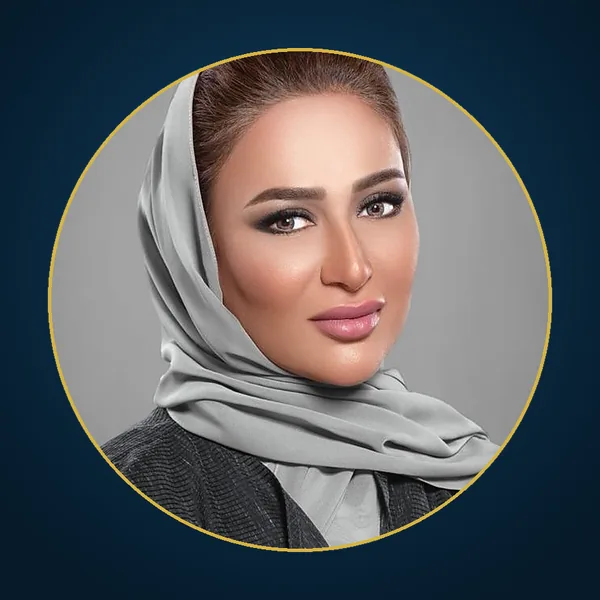
Hanadi Al-Darwish
She sees the world through a distinctive artistic lens, carrying her country’s heritage and identity into work that joins personal experience with a human message.
2024 edition · source pages 282–289
Profile
Hanadi Ahmed Al-Darwish is a visual artist, art-education graduate and cultural consultant at the Ministry of Culture whose earlier roles included Vice-Chair of the Qatar Fine Arts Society, Chair of the Girls’ Creativity Centre and Director of Visual Arts.
A Home Filled with Form and Colour
She spent nearly fifteen years in arts administration, contributing to Qatar’s national and Arab cultural landscape.
A warm, loving family first directed her creative ability towards art. Her sister became an example, while a home distinguished by architectural details and design inspired by the Qatari environment surrounded her with drawing tools, paint and varied forms. Before she could fully articulate relationships with people and the world, she was already treating still objects as capable of speech and drawing as a way to make inner states visible.
Teachers recognised the talent during her school years and encouraged her determination to build a distinctive artistic path.
She chose art education because no other specialism matched her purpose. Talent alone, she believed, could not replace the theoretical and practical strength of university study: art required both idea and skill, supported by research. She examined Arab and international movements, their differences and their place across the wider map of art, treating the degree as the formation of an artistic identity rather than the collection of a certificate.
University life included active participation in exhibitions and arts programmes. Travel further developed her ability through original works in museums and galleries, public art in parks and open spaces, private workshops and visits to artists’ studios. Encounters with different cultures built confidence and strengthened the belief that an artist represents both country and community.
Study Gives Talent a Language
A sketchbook accompanied every journey. It held observations, questions, research and passing ideas until they could be developed into artistic form.
Her Highness Sheikha Moza bint Nasser was a decisive example of leadership, opening space for Qatari women to realise their abilities, represent the country and enter fields that had previously seemed closed.
After graduation, she taught drawing for one year and then joined the Curricula and School Textbooks Department, specialising in the design and production of textbooks. She loved the world of books, the sound of pupils in the morning and the work itself, yet art remained the direction she wished to pursue fully.
More than two years on the board of the Girls’ Creativity Centre led to over five years as its Chair. She treated the centre as an incubator for talented girls, established programmes to develop their abilities and drew on international practice to modernise training. The role affirmed her belief that art was a national responsibility connected with forming the next generation.
While chairing the centre, she met His Excellency Dr Hamad bin Abdulaziz Al Kuwari, then Minister of Culture, during several visits to its exhibitions. He invited her to join the Ministry of Culture, a decisive step that allowed her to apply accumulated experience to a wider understanding of art’s place in life.
Arts Leadership Becomes a Public Role
Her formal appointment was issued on 13 March 2013, a date she retained as the marker of an important professional transition.
As Director of the Visual Arts Centre, she helped extend a leading institution in Qatar’s visual-arts movement towards international engagement. Artists gained wider access to exhibitions and major events abroad, while activity within the national fine-arts scene increased.
International exhibitions, cultural years and other external engagements enabled her to present Qatar’s culture and customs through a period of particularly productive arts administration.
A merger in late 2016 between the culture and sports-and-youth portfolios interrupted work she had expected to complete in the field.
Dar Hessa Carries Memory Forward
After the merger, she became a cultural consultant at the Ministry of Culture. Finding routine office work restrictive after years in arts practice and administration, she established Dar Hessa for the Arts in 2019 to advance Qatari visual art at home and abroad through an integrated vision of the country’s culture and heritage.
The project was named ‘Hessa’ in gratitude to her mother, who represented both homeland and identity. The name became a standard against which every activity was expected to honour that personal and cultural inheritance.
Dar Hessa was conceived as an incubator for Qatari art and as its representative beyond the country through exhibitions, activities and partnerships.
Its first initiative, ‘We Are All For Them’, was organised with Qatar Charity during the Covid-19 pandemic. Artists donated works whose proceeds supported families affected by the crisis, particularly those who had lost employment, and the initiative attracted a strong response.
Dar Hessa also organised ‘Directions’ with the Cultural Village Foundation, Katara. The first edition was a virtual exhibition during the pandemic and brought together leading artists from Qatar and abroad.
A Qatari Voice in International Art
In May 2023, she represented Qatar at the International Symposium for Contemporary Art in Morocco alongside artists from Arab and other countries. She also participated in the Carthage Contemporary Art Days in Tunisia in June 2023, using both gatherings to exchange experience and remain connected with new artistic developments.
As guest of honour at the International Art Forum in Serbia, she became the first artist from an Arab country invited to the gathering since its foundation. The appearance was also the event’s first Qatari, Gulf and Arab participation.
A recurring challenge was the pressure of dominant cultures on weaker or less secure ones. Her response was to use the brush deliberately to articulate Qatari culture and affirm national identity.
Periods of creative hesitation and anxiety sometimes led her to stop painting. Distance allowed the sources of inspiration to renew, after which she returned with work that broke from repetition and opened a different experience.
She argues that Qatari women artists require active support, recognition for pioneers and dedicated places in which their work can be exhibited and sustained.